The sign in the window says this is the Newlyn Harbour Office but we thought it was the model for 221 Durella St. San Franciso in the film What's Up Doc? That's where Eunice was taken when she should have been at the party at Mr. Larrabee's house.
If you don't know What's Up Doc is, I think, one of the funniest comedies of the late twentieth century.
Tuesday, 29 November 2011
Monday, 28 November 2011
Tribute to Sheila Acton
I was extremely sorry to learn that Sheila Acton died on Monday 21 November. Sheila and I were close quilting friends when I lived in Northamptonshire and we kept in touch by e-mail in more recent years. We met when we were both members of Danetre Quilters.
Like many people, Sheila took up quilting seriously when she retired. Unlike most women of her generation she had a career in a man's field: engineering. She took a degree in engineering and later set up her own PR company, specialising in working with the engineering industry. I seem to remember that she did lots of embroidery and crafts while working and bringing up her children but I did not know her then. She was a real dynamo and when she retired she decided that she needed a new interest so she enrolled on City and Guilds Patchwork and Quiltings.
I met her after that. As you might expect of someone who had run their own business, she had a huge range of skills at everything from business and financial planning to marketing and events management. The Quilters Guild recognised this and after serving on the Regional Committee, Sheila was asked to join the Guild Council as the PR officer. This was in 2001. She was allowed to choose her own committee and she asked me to join it as the person who coordinated links with the quilt show organisers. I had just been made redundant and chosen not to take another full-time job so I welcomed the opportunity to take on something new.
Sheila and I had a great but hectic three years. It was much busier for her than me and sometimes you would have thought she was still working full-time. I learnt a great deal from her, not least in how to organise stands at large events. The Festival of Quilts started during this period and we were in it boots and all. Sheila gave the Guild lots of advice about designing the main Guild stand that faces you as you come into the show. She had very high standards and worked extremely long hours at these events. In addition to the Festival of Quilts we had stands at the Knitting and Stitching Shows and the Grosvenor shows. I will always remember how, when we did not have enough quilts to decorate the walls of the stand at the Knitting and Stitching show, she phoned me the night before and asked me to bring as many of my quilts as I could that might fit in the space available. Her husband Roy was roped in on these occasions and drove up from Northants to Ali Pali at very unsociable hours. Sheila and I also drove to various places for exhibitions and meetings, all of which gave up plenty of opportunity to discuss textiles and put the world to rights.
This was a time when the Guild was undergoing serious review and Sheila had many ideas to contribute to discussions about its restructuring and management. She took on additional tasks in order that things would not collapse. For example, when the Webmaster emigrated to New Zealand at short notice Sheila added that role to what she was already doing so that the website, which was quite new, would not collapse.
Working for the Guild at national level means you make many new friends and both Sheila and I became part of the wider quilting world as a result. She will be missed by quilters up and down the country. When the time came for her to stand down, she was able to get back to actually making quilts. She was extremely creative and I am sure her training in draughtmanship helped her in designing some wonderful hangings. She joined a group called Contemporary Expressions who made art quilts. In the summer she sent me photographs of the items she was putting into an exhibition they were having at the Northampton Shoe Museum. These were wonderful: a large wall hanging of Fred Astaire and a wonderful flapper hat. The exhibition was being taken down on the day that Sheila died so it is good to know that she had had this last opportunity to demonstrate her skills. May her memory live on in the work of quilters in Northamptonshire and in the legacy of the Quilters Guild.
Photo of the day
Given my inability to post to this blog recently I have decided that the answer might be to do postings of individual photos. So here goes with a shot I took yesterday at Newlyn harbour. Newlyn is a wonderful sources of inspirational photos if you are into rust and industrial detritus. You have to go on a Sunday, though, as it is one of the busiest fishing ports in the country.
Here are some crab pots.
Friday, 7 October 2011
Frescoes at Piona Abbey, Lake Como
We saw lots of frescoes on our Como art history tour. I was not able to photograph all places because of issues such as 'no photographs allowed', poor light etc. but I was really pleased with those places where it was possible. One of these was Piona Abbey which is situated at the head of the lake on the Lecco, i.e. eastern, side. We went up the lake by boat. There are wonderful views across the lake at this point, even when as on this occasion, there is a lot of mist around.
The monastery was originally a Cluniac foundation but it now belongs to the Cistercians who were given it by the former owners, the Rocca family, in 1938. There is a complex of buildings and lovely gardens that stretch down to the lake's edge.
It was Sunday and Mass was about to begin so we could only have a quick look at the frescoes in the church itself. However, the adjoining cloister is wonderful and has a whole wall of medieval scenes.
The individual panels represent saints and peasants. These include George and the Dragon,
St Catherine on her wheel,
and I think this one is St John the Baptist minus his head.
The peasants give a real flavour of everyday medieval life:
Most of them are involved in field tasks:
but there are also one or two of people having fun such as this musician:
The abstract patterns that make up the dividing portions are also interesting to textile artists. We saw patterns similar to these in other places. Lozenges appear to have been a popular shape for tiles on both walls and floors. The abbey lay on the pilgrimage route from northern Europe to Rome. A very narrow road winds along the edge of the lake and later we visited a church which had a shrine to St Thomas a Beckett.
The monks today make money by selling a particularly fiery liqueur known as St Bernards Elixir. We were cautioned against adding it to our coffee!
The monastery was originally a Cluniac foundation but it now belongs to the Cistercians who were given it by the former owners, the Rocca family, in 1938. There is a complex of buildings and lovely gardens that stretch down to the lake's edge.
It was Sunday and Mass was about to begin so we could only have a quick look at the frescoes in the church itself. However, the adjoining cloister is wonderful and has a whole wall of medieval scenes.
The individual panels represent saints and peasants. These include George and the Dragon,
St Catherine on her wheel,
and I think this one is St John the Baptist minus his head.
The peasants give a real flavour of everyday medieval life:
Most of them are involved in field tasks:
but there are also one or two of people having fun such as this musician:
The abstract patterns that make up the dividing portions are also interesting to textile artists. We saw patterns similar to these in other places. Lozenges appear to have been a popular shape for tiles on both walls and floors. The abbey lay on the pilgrimage route from northern Europe to Rome. A very narrow road winds along the edge of the lake and later we visited a church which had a shrine to St Thomas a Beckett.
The monks today make money by selling a particularly fiery liqueur known as St Bernards Elixir. We were cautioned against adding it to our coffee!
Wednesday, 5 October 2011
Lake Como and the silk industry
My trip to Lake Como was a great success with beautiful weather every single day and lots of medieval frescoes to study. Before I went to Como I had no idea that it was famous for its silk production but we were lucky enough to be given a tour of the Silk Museum http://www.museosetacomo.com/index.php which is prviately run and squashed into the basement of a polytechnic. The Lake Como area began producing silk in the fifteenth century. There was already a thriving woollen industry in Piedmont and this had spread to Como but by the fifteenth century there was intense competition for wool productaion from Northern Europe. The Como area had plenty of water to use for the mills and mulberries grew in the Po valley so they were able to swop from wool to silk production. I found some interesting comparisons with the woollen industry in the Pennines. Many of the mills were originally situated in small remote alpine villages and the museum's collection of looms reminded me of the mills I used to visit in Lancashire and West Yorkshire as part of my job in the late 1970s. The museum has collected these old looms and other machines and brought them down to Como in pieces. It must have been quite a job.
As with the wool barons here, the silk merchants grew very rich and built themselves beautiful houses, both in Como city and as villas on the shores of the lake.
This house is now a bank. It still has wonderful plaster entrance porches with patterns taken from the silk designs.
We saw a number of houses like this. There are also the remains of many large silk factories around the suburbs. It was interesting being in Como in September because of the proximity of Milan fashion week. Apart from a few extremely stylish visitors who I suspect were having the weekend in Como, the TV news was full of the fashion shows.
After weaving silk for many years, the Como area moved into dyeing and printing after the second world war and that is what remains. This began with jacquard production, using punch cards and designs on squared paper. In about 1979 I taught English in a small Courtaulds factory in South London where they had just introduced this kind of machinery to produce woollen fabric. (Pretty ugly it was too.) It all came back to me when I saw the machines. Jacquard braid and trimmings are apparently still produced in Piedmont but Como moved over to printing. The filament is now all produced in China. We were shown a variety of printing methods: really old blocks, silk screens, traditional rollers and modern rollers which are much lighter. The museum also has a 'chemistry lab' and a a 'physics lab' with old equipment. It is all very interesting and quite familiar in some ways to textile people.
The museum is part of a school doing foundation diplomas in weaving, chemistry and design. It is trying hard to secure proper funding so that it can move to better premises. At the moment it is only open to school groups and special parties (I was on an Art History tour with a company called Art Pursuits http://www.artpursuits.com) and given the lack of air conditioning in the basement, it will be much better if it does manage to find better premises!
It seems the souvenir of choice from Como is a silk scarf or tie. I bought a linen scarf (will take a photo of it.) It came from a posh tourist shop but I have to confess that I have never liked what I think of as Hermes style printed silk squares and that seemed to be the main thing on offer. I was not tempted which was probably just as well given the prices.
I took lots of photos of art details but did not find Como particularly photogenic. Here is a sample and I will do another posting about some of the things we saw once I have edited the photos.
Monday, 29 August 2011
Festival of Quilts and Abstract Art 2: SAQA
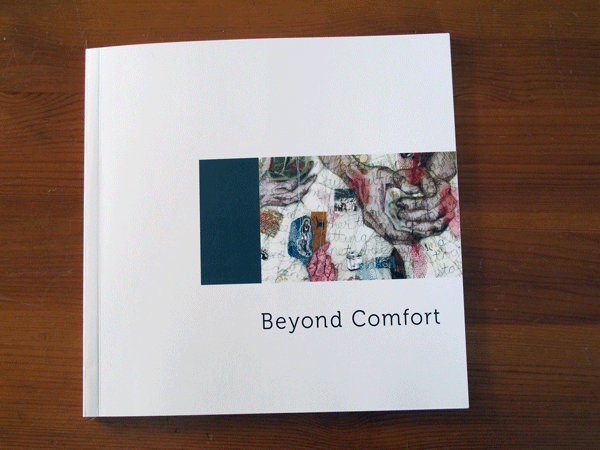
The second exhibition that inspired me was Beyond Comfort by SAQA. I have to say that I had an advantage here as I did two sessions on the stand and this meant I could study the pieces in more detail. You can see photos of the whole exhibit at http://www.saqa.com/about.php?ID=1944
and look at the individual pieces by going to: http://www.saqa.com/about.php?ID=1944
I always find the SAQA standing inspiring and this was no exception. I noticed that lots of people were particularly interested in Kristin La Flamme's three apron shaped quilts about the life of an army wife. I think the juxtaposition of symbols of traditional women's roles and the use of the apron shape really made you think about the lives these women live. Here in the south-west, huge numbers of people have careers in the military, especially the navy, and almost every evening our regional news programme has a military related item, often about yet another casualty in Afghanistan. These frequently feature interviews with the women left behind, so I could relate to the images she included as well as the messages she was giving us.
The apron quilts were on the wall behind us as we sat at the table, though, and it was the quilt immediately opposite me that I really had time to study. This was Sampler Revisited by Joan Sowada and used fabrics she had rusted. This was a very good example of putting samples together so I was interested to find another quilt by her in the Quilt National 2011 book which I received a couple of days ago. http://www.amazon.co.uk/Quilt-National-2011-Lark-Books 'Full Measure' is completely different, being a portrait of two girls looking towards the right of the picture and designed to illustrate: 'the female spirit, firmly planted and fully present'. Together these two pieces illustrate Sowada's versatility but also I think tell the amateur quilter that it is quite acceptable to vary one's style quite dramatically.
Probably one reason I liked it was because I am working on something similar: pieces of rusted fabric combined with samples from an indigo workshop. Mine is about the same size as Sampler Revisited and seeing something like this in a juried exhibition made me think perhaps mine is not so bad after all! I should have it finished in a week or so and will then put it on the blog.
On the wall to the left of us was Bad News by Elly van Steenbeek. This was another abstract piece incorporating unusual materials including a piece of iron and paper. She suggests that the piece of iron found in a park is a symbol of waste and telling us something about modern life and the environment. There were also several pieces that were virtually monochromatic. Working in tones of black and white seems rather popular at the moment and removing colour certainly draws the viewer's attention to other aspects of the design such as line.
So where do these quilts leave us in relation to the statement about abstract art in my previous posting? I like the idea that contemporary artists have dialogues with concepts and ideas that were expressed by people fifty years ago and I suspect that because quilt art is a newer medium, we probably have plenty more to say. Talking about these ideas with my husband (not an arty type), however, has also made me think about another question: if you can tell that a piece is, say, a landscape, does that mean it is not abstract? And does that mean that it is not 'worth' as much as one that addresses thoughts and layers of meaning in the mind. I don't know.
There were other exhibitions that addressed these issues so I will continue posting about them.
Festival of Quilts and Abstract Art 1
I suspect I am like many other people in finding the invited exhibitions at the Festival of Quilts particularly inspirational. There are always several that give me new ideas and 2011 was no exception. I have now had time to mull over what I saw, even though I chose to take very few photographs. I am very conscious of copyright issues these days so I tend to buy the catalogues rather than take photographs that then sit on the computer and are forgotten. This posting is therefore totally photoless!
I find myself attracted to more abstract quilts so I was very interested in how the statement below might apply to the quilts I saw. It appears in the press release for the Tate St Ives winter exhibition that opens on 8 October.
The contemporary position of abstract painting is problematic. It can be seen to be synonymous with a modernist moment that has long since passed, and ideology which led the medium to stagnate in self-reflexivity and ideas of historical progression. The Indiscipline of Painting (title of the new exhibition) challenges such assumptions. It reveals how painting's modernist histories, languages and positions have continued to provoke ongoing dialogues with contemporary practitioners, even as painting's decline and death has been routinely and erroneously declared.Does this statement, which is initially quite dismissive of abstract work, apply to art quilts I ask myself? I think overall we would say that art quilters continue to engage with contemporary issues and there were several exhibitions at FOQ where I could see this happening. The first was by a Dutch group, TEXUI http://www.texui.nl/Website-T/home-T.htm
The catalogue says that their artwork 'can be characterised as a quest for images expressing deeper layers of the mind...even a matter of aspects of everyday life gives food for reflection, are taken out of its context and given new meaning in a different order'. It goes on to say that the use of experimental techniques and materials is an aspect of this. The pieces they showed ranged from those where the viewer could recognise and identify with the subject matter (Crocodile by Elke Boesewinkel, The Wall by Jacqueline de Jong-van-Balen and Windmill by Willy Doreleijers) to others which were very abstract so that you had to ask yourself how the subject matter related to the title (Human Rights by Hanne Capel, Tape-e-stry by Annette Jeukens and light 2 by Jelly Dijkstra). My favourite, however, was Genesis-'And the Word was...' by Rita Berghuis-Ensing. So I have to ask myself what it is I am responding to. Is it the colour (because of course I am a colour freak), the overall design, or the techniques? How many of us, I wonder, respond instinctively to some combination of these and how many more intellectually to the ideas being expressed? I suggest you go to the website to see more of their work although at the time of writing I could not find a page that had all these pieces on it together.
Subscribe to:
Posts (Atom)