Thursday, 28 April 2016

Tiki's great adventure

I am writing this post because the writer of a blog I follow, dovegreyreader scribbles posted about her missing cat and asked for comments.  I decided that my story of how we lost our first cat was too long to post as a comment on her blog and that I should write a post of my own about it.  The story happened way back at the end of the 1970s but I have never written it down, so now is as good at time as any.  We have virtually no photos of Tiki, who was our first cat, because we lost most of them in our house fire in 1999 but here is one I found and have managed to scan.


Tiki went on his great adventure from our house in Tooting, London.  It was a two-up, two down in a tiny street that ran off the main shopping street.  When we went to work we used to leave the back downstairs window open for him as the houses had virtually no gardens and we figured he could not go far.  But we reckoned without this feisty Siamese whom we had acquired at the age of six weeks (far too young for him to leave his birth mother).  He was about eight when it happened on a wet Friday in November.  The street was full of parked cars because everyone came shopping on Fridays.  Tiki was an extremely fussy eater so we were really worried and his first night away was Guy Fawkes.  Later we realised that he had got out the back window, climbed over two fences and come to a house where builders were working and had left both the back and front doors open.  This enabled him to get through the house and climb into the engine of a car.  He had done it once before in the hot summer of 1976 but he did not go on a journey that time.

What do you do when you lose a cat in London?  My in-laws thought you told the local radio but that would not have worked so we just put a card in our front window.  After all, you do not expect to see stray Siamese.  We also spent hours looking under cars and knocking on doors but to no avail.  After five weeks we realised we would not get him back and prepared to go to the cat show at Olympia the following weekend and choose a successor.  Then an elderly woman who lived a few doors down approached my husband as he walked home from work and asked if we had ever found our cat because there was a stray Siamese where her daughter lived about two miles away.  The daughter lived just round the corner from a main road and a parade of shops.  So began our attempt to get him back.

We put a 'small ad.' in the newsagent's window with our telephone number on it.  Nothing.  I was commuting to near Heathrow and one day I had a phone call at work saying the cat had been seen behind the parade of shops.  Hopeless.  It would have taken me an hour to drive back.  At the end of the week we had a phone call from someone who said he lived over the DIY shop and that our cat was living behind the shop.  He had moved across the side street where our neighbour's daughter lived, after spending several weeks trying to make friends with them.  That was when we knew he had definitely got into the engine of their car on their regular visit to her mother.  The man who phoned said he worked in a butcher's shop and was bringing Tiki home choice cuts of rabbit etc. so at least we knew he wasn't starving.  The man said he could shut him into the back of the shop and would then phone us to come and get him.  Saturday evening came and we did not get the expected call.  After watching a movie on TV my husband drove out in heavy fog to find him.  When he got there he locked himself out of the car and had to walk two miles home in the fog at midnight to get the spare key.

Next morning (Sunday) I was woken by the phone to say Tiki was 'caught'.  But even that was not simple.  Apparently our phone was not working properly and directory enquiries initally refused to help.  But the man refused to give in so the cat was found!  When we got to him he had the biggest fleas I have ever seen but he did recognize us and purred madly.  We had been told that he was likely to go feral after so long away so we were very lucky.

This was not his only adventure.  The summer 1976 episode revealed him when he fell out of the car engine in our street covered in oil.  We had to rub him with butter and then put him in the bath and shower him.  Not popular.

The year after his big adventure we moved to a larger house.  He was only allowed out when we were home but that did not stop his adventures.  One November Sunday afternoon he came in from the back garden, shot straight up the stairs and out the bow window at the front of the house.  I think he had learnt his lesson and he spent the afternoon cowering behind the dustbins of the house opposite until I heard him and we rescued him.

I am afraid we did finally lose him but by then he was fourteen so he may have gone away to die.  We were in the process of leaving London and I was working in Oxford and only home at weekends.  My husband would let him out into the back garden (we were still in a terraced house) and then put the carving steel against the carving knife to call him in before he left for work!  It was summer this time.  One day he did not return.  We spent hours knocking on all the doors and got our young nephews to post 'lost' notices through the doors of all the houses in our street and the next one behind the gardens. The house immediately behind us was on the market so I got the estate agent to come out and go through all the rooms.  But we never found him and concluded that he had either wandered off to die or hitched a lift in yet another car.  It is for that reason that all our other cats have been more or less 'house cats' who have only ever gone out under supervision.


This is the only other photo I can find apart from two negatives which I must get prints from.  You can see from this photo that he as a boz-eyed Siamese.  They were very common in those days, much less so now.

Monday, 7 March 2016

Patchwork dogs

On Christmas Day I posted about the quilt top I made with dogs on it.  I am afraid it is still just a top because I do not seem to have any pieces of fabric large enough for the back and need to decide whether to buy something or to attempt to piece the back.  The same article in Todays Quilter had a pattern for soft toy dogs so I have been making these out of various scraps.  They are obviously ideal as items for charity stalls but I have not yet decided what is happening to them.


Here is one made from batiks.


And here is one made from primary colours.  As you can see, it is difficult to get the long strip that joins the two sides to meet at the right point for the corners.  The second dog has a distinctly peculiar angle to its ear but I am afraid it will have to stay like that.  Now I plan to make some that are more 'grown up' in proper dog-like colours.  It does not take long to make the sides.  It is just the joining strip that causes the problem.  I have given them felt eyes as then they are suitable for babies.

Lesser known books about Katherine Mansfield

I grew up in an atmosphere full of Katherine Mansfield.  We lived in a street in Karori, Wellington named after her father who had originally owned the land on which the street was built.  As children one of the 'dares' was to go into Chesney Wold, a derelict house on the edge of Karori Park which had been the home of the Beauchamp family and which is the setting for a couple of the stories.   Katherine attended the school I went to and other places that feature in her New Zealand stories were situated in parts of Wellington that I knew well.  As Wellington was a small colonial town at the beginning of the twentieth century, my maternal grandmother's family had known her family although interestingly my mother was not a fan of her work.  Maybe it was too radical for NZ tastes in the 1930s!

We also 'did' the short story as a literary form when I was in the sixth form.  As a result I have always read short stories but it was only as an adult that I learnt more about Katherine Mansfield, her links with the Bloomsbury group and modernism and, later, more about her life in NZ.   In the 1980s I read a library book about the trip she made in the central part of the North Island in 1907.  I had always wanted to read this again.  My father came from Hawkes Bay and we lived there before moving to Wellington when I was eight.   My paternal grandmother took me to Taupo for the first time when I was six and she pointed out the places where they broke the journey at the beginning of the twentieth century and told me all about  the country as we went.  It was extremely rugged terrain and steps had to be taken to prevent children being car-sick!  These stories have stayed with me so I was very pleased when I managed to track down what appeared to be the book I had read back in the 1980s: The Urewera Notebook   


Actually I am not sure it is the same book as this recent book by Anna Plumridge is not simply the diary of the trip but an analysis of the different editions of it.   I have learnt a lot about book editing from it.  Then I got out my copy of Katherine Mansfield's New Zealand which is a book of photographs compiled by Vincent O'Sullivan, a well known Katherine Mansfield scholar who taught us at university.  I think it is now out of print but when I opened it I found several pages of photographs of the area of her trip.  They add to my memories of my grandmother's stories.


Finally, I have also recently read 'My Katherine Mansfield Project' by Kirsty Gunn.   My Katherine Mansfield Project  Like The Urewera Notebook, this book considers Katherine Mansfield in context, in this case definitions of 'home' and identity with particular reference to Wellington.  The author spent a winter in Wellington and her descriptions of the weather (the famous Wellington wind) and the light are very vivid to those of us who grew up there.  The question of whether you can have two homes is also one that applies to all migrants so I have been recommending this book to friends.

Wednesday, 3 February 2016

British Council films of Cornwall

Last week I discovered the British Council Film Collection.  British Council film collection  There are apparently 120 short films in the collection, mostly made during the Second World War and digitised in 2012-2013.  They describe aspects of everyday life in Britain and I have to say that the commentaries come over as propoganda films which is hardly surprising.  One could obviously spend a long time viewing them as they are quite fascinating as 'period pieces'.  The commentaries capture English Received Pronunciation as it was in the 1940s although the actors do not speak so I have not yet found any regional accents or dialects.

I have discovered that no fewer than three of these films feature West Cornwall.  Coastal Village is the story of everyday life in Mousehole, a fishing village two miles west of Penzance


 https://en.wikipedia.org/wiki/Mousehole   The wikipedia entry is good so I will not give a potted history here.  Having watched the film I remembered that a whole school of Jewish children were evacuated there from the East End of London and that there is a book about this by Susan Soyinka. The book is called: From East End to Land's End.  I have now bought it and am finding it very interesting but you would not know these children had been there from the film.  The film focuses on the daily routine of the village but the book has much more detail.  As someone whose forbears made Cornish ranges in New Zealand, I had not realised that communal bakehouses were still common here as late as the mid-twentieth century.  They often appear in paintings from the Newlyn School but I now know they were huge and took large quantities of fuel so people only ran them in winter.  Mostly people took their baking to the local bakehouse.


Having watched the first film, I looked to see what else there was of this area.  I have found two:  Sailors without Uniform, which is about coastal fishing.  It has plenty of 'PZ' boats and finishes with shots of Salubrious Terrace in St Ives, and S.O.S which is about the Penlee lifeboat.  This lifeboat, which is now based in Newlyn, became famous after a terrible storm in 1981 when the whole crew were lost trying to save a steamer.


Films were also set in other parts of Cornwall so if you have Cornish connections I would recommend using the 'search' facility on the introductory page.  The films are short (mostly ten to fifteen minutes) so good for a 'coffee break'.

My only complaint about these films is that one of the 'posh' narrators pronounces Mousehole as Mouse hole the whole way through when anyone who knows anything about the place knows that the pronunciation is 'Mowzel'.

Friday, 25 December 2015

Recent work

Christmas greetings to everyone. I hope you all have/have had a good day.  I had hoped to get this post done yesterday but Christmas tends to bring unexpected tasks.  This year I have received a wonderful number of e-mails from friends all over the place and have been quite busy replying/sending mine out.  However, Christmas Day has dawned very gloomy here so I have time to write this post.  In fact it is so gloomy that here is a photo of Penzance taken on Christmas Day last year.  Please note the rainbow!  We will not be going out today!


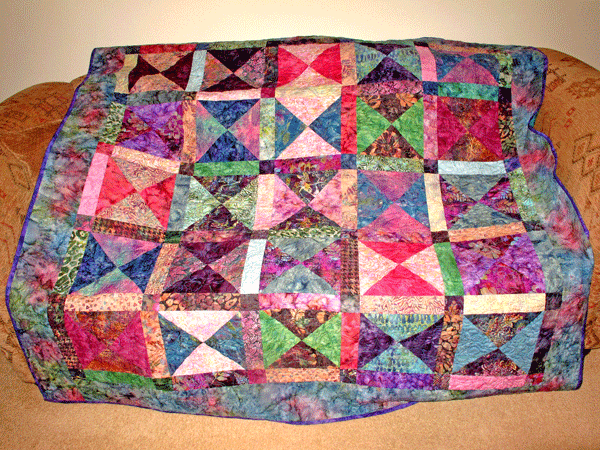
Although 2015 has not been a good year for my textile work, I have not been entirely lazy.  My main project over the summer was a lap quilt as a sixtieth birthday present for my sister-in-law.  As I no longer quilt large pieces it went off to be long arm quilted.  I have not been able to post it on here until now as her birthday was only last week and I know she reads my blog.


If this looks vaguely familiar it is because the top is made from left over blocks from my own bed quilt.  As my bed is so big I had to buy two packs of jelly rolls and two packs of squares but only used a few of the second packet.  I had enough left over (with the addition of a few from my stash) to make a lap quilt.  The border is the fabric that backs my quilt but the backing is not the same.

Recently I decided that I should make a determined effort to use up some of my stash and that the time has come to make quilts for charity.  I have a lot of 'children's fabric' from many years of making cot quilts.  I do not normally buy quilting magazines but on a recent trip to Sainsburys I found a new quilting magazine,  Today's Quilter which had a pattern for a quilt with dogs on it.  The author said she was inspired by the London  quilting shop 'The Patchwork Dog and The Calico Cat' which existed over thirty years ago.  That really took me back as I remember the shop well.

So I have started to make a quilt that uses up some of my children's fabrics.


It is very much a 'work in progress' as Christmas intervened and you can see that I am still making the dogs.


My problem is that I resolved not to buy fabric for this project but find I have almost no larger pieces.  As the blocks have sashing between  them I am going to have think carefully as to whether I can manage without buying anything more.  We all know that not having enough fabric for a project is a perennial quilter's nightmare and is one way in which people build up stashes.  My aim is to reduce my stash!

I am not a neat worker so doing more 'traditional' work like this is a slight challenge. I tell myself it will do me good and that I will get back to art quilting in 2016.  So Happy New Year everyone and happy stitching to those of you who are quilters.

Tuesday, 6 October 2015

Tehidy Country Park

Tehidy Country Park is a great place for a weekend walk, if you can cope with the high noise level!  This is the result of its being the nearest area of open space to Camborne and a very popular place with families, especially those with small children as it is buggy friendly and ideal for learning to ride a bike.  We went there on Saturday and went for a short walk round the lakes.


The reflections in the lake were lovely.


There are miles of paths and it is possible to walk right down to the the north coast but there are some  paths that are easier than others and that is what we use these days.  Even so, it can be difficult to find places we have visited before and on Saturday we never found this interesting area with a terraced stream.


Another attraction for families is the wildlife. There are swans and ducks on the lakes and a lot of other species although they are not easy to see when the park is busy.   Within minutes of starting our walk we saw two grey squirrels and then a water rat emerged from the lake.  As you can imagine the wildlife is very tame due to all the visitors.


Tehidy has an interesting history.  It was the home of the Basset family who owned a number of mines (tin and copper) in the area of Pool and Redruth and were extremely rich as a result.  The park itself is in Illogan which lies between the A30 and the North Cornish coast.  The Basset family Basset family can be traced back to the Norman Conquest.  There have been various houses on the site, including one that was built between 1861 and 1863 when Cornish mining was at its height.  As is well known, tin mining began to decline around the 1870s and this effected the family badly.  The result was that during the First World War the family sold the house and it became a TB hospital.  The hospital was completely destroyed by fire in 1919 but then rebuilt and remained as a hospital until 1988. In 1983 the whole property was taken over by Cornwall County Council and turned into a country park.  The original house is now very upmarket apartments and there is a small estate of upmarket housing around the house.  There is also a golf course adjoining the park.  A trip here is a nice contrast to coastal outings.


Thursday, 6 August 2015

The battle of Chunuk Bair (Gallipoli campaign) and family history

This post is somewhat 'off topic' for this blog but it is the centenary of the Battle of Chunuk Bair next Saturday (8 August) and I feel that I should remember it.  Most Australians and New Zealanders see 25 April, 1915 as a very important day in their countries' histories but 8 August is equally important and it is now suggested that this is the day that forged New Zealand's identity.

My maternal grandfather, William Cunningham fought in the battle but like most people he did not really talk about it.  As a child I knew that 8 August rather than 25 April was the day he used to commemorate and that he had been shot and had the bullet in his shoulder until the day he died. I also knew the name Mustapha Kemal Ataturk (commander of the Ottoman forces).  My grandfather was carrying a small bible in his backpack when he was shot.  The bullet grazed the bible's cover and it was a very precious object which I inherited.  I am not a historian so the other details passed me by.  When I lived in Australia in 1968 I realised that Australians consider Anzac Day to mark the foundation of the Australian nation, as it had originally been settled as several separate colonies and they saw the Gallipoli campaign as the first time they were 'Australian'.  I do not think New Zealand had the same feeling in my youth but in recent decades, as the country shed its colonial past, it became more like Australia in its view of the birth of the nation. Now 'going to Gallipoli' is considered a very important part of young New Zealanders' 'OE' (overseas experience).

It was only this year that I began to find out more about Chanuk Bair.  At the Anzac Day centenary commemoration at the Cenotaph in Whitehall the BBC interviewed the family who had the most descendants present (there were almost forty of them).  When they said their name was Malone and mentioned the Wellington Regiment the penny began to drop and I rushed to find out what I had on the computer as that was my grandfather's regiment.  Now several of my school friends have been in touch to tell me about the exhibitions that are on in Wellington this year  http://gallipoli.tepapa.govt.nz and to point out the role my grandfather played in the battle.  It was a horrendous battle and much has been written about it.  My grandfather was second-in-command to Colonel Malone https://en.wikipedia.org/wiki/William_George_Malone and when Malone was killed by friendly fire my grandfather took over only to be seriously wounded some hours later.  Apparently everyone who was in the trench with Malone apart from my grandfather and one other, were killed and Colonel Malone collapsed into my grandfather's arms.  The Wellington Regiment held the ridge but two days later the Ottomans under Mustapha Kemal Ataturk counter-attacked and they lost it again.  Of the 750 members of the Wellington Regiment who reached the summit, 711 were killed or wounded.  Photographs of the ridge show it to be  incredibly steep and they must have been extremely fit to climb it.  Colonel Malone was 56!  And we always thought of my grandfather as being older than most of those who fought. (He was 31.)

Of course there were other regiments at the battle in addition to the Wellingtons and these also suffered terrible casualties.  The Auckland regiment was basically wiped out because they ascended the ridge in daylight.  Colonel Malone refused to do this so the Wellington Regiment went up under cover of darkness and reached the ridge about 3 am.  There were also very heavy casualties in the Christchurch regiment.  But the battle was not fought just by New Zealanders.  There were also English and Sikh regiments. There were 417 casualties among the 'New Army' Welch pioneers and 350 casualties in the Gloucestershire regiment.  If you are into military history (you can tell I am not) follow the links to read the details

It is interesting looking at what has been written in relation to our knowledge of more recent conflicts and how battles and wars are reported at the time and them much later.  Letters, including those written by my grandfather, turned up decades later and led to a reassessment of the battle, there are books and a play by Maurice Shadbolt: Once on Chunuk Bair.

I am sorry this post has no illustrations but I have been defeated by the problems of copyright in using photos from the Web and I notice that the relevant Wikipaedia entries to not have photos either.