Saturday, 10 May 2014

UFOs

All quilters have UFOs (unfinished works) and I am no exception.  Mine go back over a number of years and I am getting tired of finding them lurking in various boxes and plastic bags.  So I have decided it is time to finish some of them.  Of course others should probably just be binned and accepted as having taught me something, e.g. a new technique.

I thought I would start with a recent piece.


This one only dates from the beginning of this year as I planned to do the Contemporary Quilts group's journal quilt project this year.  This was my January square and I also have a second unfinished one but I then realised I could not cope with working to deadlines these days so  I pulled out.

We had terrible storms at the beginning of this year and this piece was inspired by them.  It is made from pieces of fabric that I had lying around.  The background is indigo-dyed linen which I made on a workshop with  Janice Gunner several years ago.  The contrasting squares are space-dyed linen which I made nearly ten years ago.  The colours reminded me of the way the sea is churned up in a storm.  The Journal Quilt Challenge this year said you had to include a line across the whole piece so I used a fancy white thread and couched lines of it between the shibori markings.  I then hand quilted between the white lines using a Kanta technique and quite large stitches.  The squares were then hand-stitched in variegated thread in an irregular pattern.  I chose colours to reflect the colours in the linen.  Then I added some French knots to give a bit of texture to the piece.  The binding is plain blue dupion silk.


Now that it is finished it has migrated from the shelf in the studio to a folder with other journal quilts.  I have no idea what I will do with it but I think it is successful as an exercise.  I rather like the use of small squares mounted on something and frequently admire them in other people's work although I have not used them that extensively myself.

Monday, 5 May 2014

Hedgerow wild flowers Part 2

On my second walk up the valley towards the moors I noticed plants I had not paid attention to the first time.  Identifying some of them has proved difficult even with the aid of the Web.  The umbellifer family is huge and includes many common garden plants and herbs.  It is quite early in the season for them as the majority flower in June and July but I noticed two distinct types of plant.  The first has yellow/green flowers and interesting patterns of umbels.


The second is white and I think this is cow parsley.  It is certainly very prolific and grows throughout the hedge at all heights.


The other white flower which is out at the moment is onion weed.


This is a plant from my childhood as it grew wild on our walk to school.  It also smelt very strongly of onions so was generally known as 'stinky weed'.


 Here it is often found growing alongside bluebells as in the piece of woodland this road passes through.


The other things I noticed on this walk (apart from a solitary wild strawberry flower) were buttercups, dock and gorse.


 We have two varieties of gorse in Cornwall: one flowers at Easter and the other in August. This is the spring flowering one and grows as bushes at the tops of the Cornish walls.  The August flowering one is generally more prolific.  When I checked my father's book, I found he had seen the early flowering one (U'lex europaeus) at Reifenberg in Germany in May and Welsh Gorse, the late summer flowering one, in Reifenberg in June, so perhaps the flowering periods are not so clear cut after all!


Finally, dandelions.  Embroiderers love dandelions and I always associate them with Danish cross-stitch kits.  We are plagued with them in our lawn and when I see them growing wild so near to us I can see why.


On this occasion, I found a near perfect dandelion 'clock'.  Amazingly no passing cars or horses and caused the thistledown to blow away.


Friday, 2 May 2014

Wild flowers in the hedgerow

From time to time I realise that there is still a great variety of wild flowers in Cornwall.  We all know about the dangers of crop sprays and of how the number of wild flower has decreased hugely since the Second World War but when I went for a walk up the valley that leads from here to the moors a couple of days ago I was surprised how many different flowers I found.  I was also able to compare the flowers with the ones my father had seen in 1945.  He was serving in the RAF, having been seconded from the New Zealand air force, and he bought  this little book which he annotated with dates and places as he saw things.


So here are some of what I saw this week together with information about where my father saw them.


The primroses are coming to an end.  In this valley they grow on the sides of the Cornish hedges (which are built of granite boulders infilled with earth) so they often seem pale compared with the ones in gardens.  My father has noted primroses, cowslips and oxlips in Stoke Holy Cross near Norwich in April 1945. I do not think I have ever seen an oxlip and I see that the book says they are confined to Suffolk, Essex, Cambridge and Herts. The book dates from 1935 so I would not be surprised if oxlips no longer exist.


I always associate bluebells with May but they often appear here in April. Maybe I am wrong because my father saw them in Cardington which I see is in Bedfordshire in April.   I can remember when it was difficult to find them and we used to make special trips to places with bluebell woods but they have spread everywhere now and these were just in the hedgerow.  We even have them self-seeded in our front yard.


This is greater stitchwort.  It has a long flowering season these days and is described in the book as common in hedgerows throughout Britain.  My father saw that in Swyell in March.  I think Swyell is in Northamptonshire which makes sense as I know my father was stationed in Northamptonshire over the winter of 1944-45. 


Red campion is another flower with a long flowering season and I notice I have some photos of it taken with foxgloves in July.  My father saw it in Norfolk in April and again at Refenberg in the Taurus mountains near Frankfurt am Main in June.


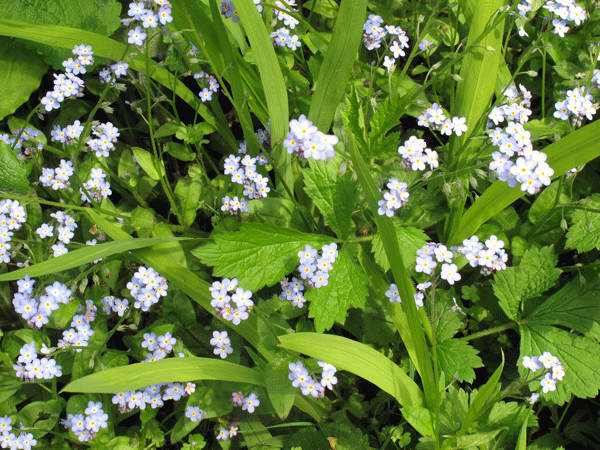
I think the forget-me-not has spread from someone's garden although Skene describes it as a wild flower and my father saw it at Stoke in April.  I am not sure about this next one.  It may be is a gentian or a member of the forget-me-not family but I find it difficult to identify and it could even be a bugloss although to me that is a hairy plant which flowers later.


I will do a second post about flowers from this walk as some of my photos were not in focus and I need to retake them.
 
On this occasion, the thing that I really noticed was the sycamores coming into leaf.  They self-seed everywhere here and I am constantly having to pull them out of the garden.  I don't particularly like fully grown sycamore trees but the new leaves on the tiny plants emerging from the hedgerow have some lovely colours and good shapes and have potential for design work.


Saturday, 5 April 2014

Church wall paintings at Breage

When we lived in Northamptonshire we stumbled on the medieval wall paintings in the parish church at Slapton which was a short walk across the fields from where we lived.  Although I took a few photos I did not really know what I was looking at and I had no knowledge of the tradition of medieval wall paintings.  This all changed recently when I joined a group visit to the church at Breage.

Breage is a village between Penzance and Helston.  The church is Gothic and was built in the fifteenth century.  It is dedicated to St Breage or Breaca who was an Irish nun who came to Cornwall in the fifth century.  There are 144 Celtic patron saints in Cornwall with more churches being dedicated to them than to more commonly known saints.


Although Breage is only a few miles from here I had never been there.   There are four saints depicted in paintings on the North wall.  This is St Christopher and is situated next to the door.  I believe that is the traditional place for him.  Here he represents 'sudden death' rather than his usual association of travel.   There are three other saints on this wall: Ambrose, Corentine and Hilary.

There is also a 'Sunday Christ'.  This is a large figure of Christ designed to discourage Sabbath breaking and blasphemy, i.e. it is a warning to those people who work on Sundays.  The tools of the trades of Sunday workers are used as illustrations.


Local occupations are represented which means in Cornwall there are often fishermen.  I am afraid the quality of these photos is poor but here you can see the tools of the tailors whom I imagine just worked away at home and there are fishing tools including a fishing reel between the saint's legs.  It was common to put locally specific things at the bottom of the painting.


Fish and other things to do with the sea are popular in Cornwall and this painting has a mermaid with a mirror and a large plaice.


I was interested to see that my photos of Slapton also have a mermaid and that is miles from the sea so I am wondering if it is also telling another story.

The churches also had paintings of 'international saints' which in Breage includes St Thomas a Becket.  International saints generally appear on the South wall.  The subject matter of the paintings is always the lives of saints and not bible topics which only appeared at the reformation.  I expect that helps to date them.

We were told that there are also paintings in St Just which I must have seen years ago and need to revisit.  I would also like to revisit St Keverne at the tip of the Lizard peninsula which is where my great-great grandmother was born and brought up.  It apparently has some good paintings but the day we visited they were installing a new heating system and it was not really possible to study the church.  All I remember is the large numbers of graves from shipwrecks on the Manacles rocks below the village.

Apparently the Breage paintings are quite late as the church was very new at the Reformation.  The aisles were probably decorated when they were built.  After the Reformation plaster was introduced and all the paintings covered up.  We were told the Victorians had removed the plaster but this cannot always have been the case because I remember the Slapton paintings were only uncovered in the mid-twentieth century.

Friday, 28 February 2014

Reworking a quilt for the next generation

I have just had a telephone conversation with my sister about the cot quilt I made for one of her sons in 1977.  Now it is time for the quilt to be resurrected for his first child which is due in May.  I had almost forgotten it.  It was a very early effort and has one or two strange features.  Don't ask me why each block is satin stitched, for example.  I think a lot of us began with Laura Ashley squares because you could buy them ready cut.   Most of us taught ourselves in those days and it obviously shows as my sister says the binding is a bit peculiar!  However, the colours have lasted well so after a gentle wash it can be brought into the twenty-first century.


At the time, my sister and her family were living in Cairo where both this nephew and his younger brother were born.  Because of the climate I chose not to put any wadding in it.  There is absolutely no quilting on it but it does have a border and a backing.  The new baby will be living in Los Angeles so an unlined quilt seems a good idea for a Californian summer.  My sister is planning to add some quilting to the plain squares and to machine a quilting pattern on the border. Then she plans to sign the quilt with the initials and date of birth of father and son/daughter.  She has also suggested that I sign it (better late than never).  Since we live in different parts of the country I plan to do that on a small piece of fabric that I can post to her.  Now I am wondering the best way to do it.  These days I generally print the label on the computer using iron on transfer paper but I am not sure if this will wash.  I may be better to write on the label with a Pigma pen or even to stitch a label.

This baby is going to have lots of hand crafted presents as the family is full of people who do textiles of various sorts.  I have decided I am not making a quilt as I want my sister to take my present when they visit rather than having to deal with US customs.  I have just started on a foundation pieced wall hanging, using patterns from Margaret Wolfe's book: The Quilters Ark. http://www.amazon.co.uk/Quilters-Print-Demand-Margaret-Rolfe.  I am choosing patterns from countries where the family have lived although unfortunately there is not a pattern for a kiwi to represent the New Zealand root and I cannot find anything small enough on-line.  The baby's mother is half-French so I am thinking about an appropriate animal/bird for that side of the family, too.  I find foundation piecing slightly infuriating to do although once you are into the swing of it, it is reasonably quick.  All will be revealed in due course.   In the meantime here is a photo of a similar wall hanging I made last year.

Sunday, 26 January 2014

Current discussions in art quilting

There has been some interesting discussion on the SAQA Yahoo group over the last couple of weeks and I have used the 'conversations' to help me reflect on where I want to go with my quilting this year.

It began with people saying that they thought art quilts are becoming smaller.  Much of the comment was based on observation of what is being accepted and rewarded in quilt shows but the topic is of interest to those of us who choose to work small.  I would agree with the statement that bigger pieces have more impact.  However, here in the UK, most of us live in smallish houses, often with small rooms and this may influence our work more than we realise.  While we do not work with the idea of displaying our quilts in a domestic setting, it is nice to be able to have a few on the walls.  I have several framed journal quilts on the landing but only one larger quilt.


I made Gwithian Two about a year ago.  It is 72 cms wide by 58 cms tall and fits nicely on the landing wall even if you can't stand back from it.  There is Gwithian One but that has had to be put away as our walls are quite full of art work of various kinds.  The second problem with small houses is room to display 'work in progress'  I have two large pieces of foam insulation board as my design wall and generally prop these up against my workbench.  Most people I know do not have purpose built studios and have various arrangements for design walls such as pieces of fabric that can be propped against doors.

A second thread in the SAQA discussion has been the use of commercial fabric.  I have vast quantities of 'bought' fabric but I doubt whether I will use a lot of it as it seems to 'age' and you get fed up with looking at it.  Over the last year I have made several pieces that were patterned but I would not call these art quilts.  They include two new quilts for our beds, a small quilt for a charity and a wall hanging for the new baby next door.  I was prompted to follow a link from SAQA to Judy Dales' website to see how commercial fabrics can be used.  www.judydales.com I am too fond of batiks and really need to think of ways of using the vast stash I have of that.  I know I can overdye etc. all the other old stuff but at this time of the year wet work does not appeal.

The SAQA conversation also remarked on the lack of piecing in art quilts.  Good point.  I always wanted to 'paint in fabric' so just being able to collage everything was very appealing as I got into art quilts. I have to admit that I had to stop and think quite hard when I made the quilts last year as I had almost forgotten what was entailed in pieced work!  It is apparent that all these traditional approaches have been replaced by a wealth of techniques for manipulating fabric: dyeing, painting, stencilling, using thermofaxes etc.  Been there, done that so which ones do I wish to continue with?

And finally the conversation moved on to the use of digital images and one's own photographs.  Again I have done this a lot.  I am a keen photographer and I am happy with the idea of manipulating images and printing them out, sometimes with good results.  But I am not sure that this is where my real interest lies.  Having said that, this morning I was searching through my old sketchbooks and found the notes from an A4 quilt I did with photos of nets.  I see from my designs that I planned to make a larger quilt with this design and I am wondering if I should revisit it.  One thing about digital photography is that you have the database to hand.


So where did my musing over the SAQA conversation leave me?  My first task is to identify a subject for this year's journal quilts.  It has been a slow process but I think I have just about got there.  I looked at Lisa Call's work lisacall.com and was really inspired by her quilts of Thai temples.  The technique has similarities with Kathy Loomis's kathleenloomis.com, particularly in its use of narrow pieced strips.  I mastered this technique some time ago (it is much more difficult than it seems) and I can see that some of the photos I might use for my journal quilts this year would lend themselves to it well.  Not that I propose to use other people's work as more than mere inspiration. So the next step is to do some art work on the images.  Here's hoping I have a way forward.

Thursday, 23 January 2014

Balkan textiles

I have just been checking the state of my blog which had a very bad year in 2013!  I discovered that I had a draft posting about some Hungarian textiles and that after an initial post about Budapest, I wrote nothing about the rest of the cruise I did with my sister and her husband in June.  So here, very belatedly, is the post I did on our visit to the Paprika Museum.

My initial contact with Balkan textiles was in 1972. We spent our honeymoon in what was then Yugoslavia.  When we just about ran out of money we took to travelling overnight by coach to save accommodation costs (I have been over the old Mostar bridge but cannot really remember it!) and ended up spending three or four days in Sarajevo.  It was incredible and I would never go back because of course most of it no longer exists.  But I do remember going to several museums including one with a wonderful collection of embroideries.  In fact I was inspired to make a cross stitch tablecloth to a design from a book I found in the Needlewoman shop in Regent St.  I still have the book and the tablecloth.

From what I had seen in 1972 I knew that embroidery was an important part of Balkan culture.  My sister is a weaver so she was interested in textiles too.  We had hoped to visit the Ethnographic Museum in Budapest but it is an old house with a lot of steps up to the entrance and I decided I could not risk falling up or down them.  A real nuisance.  On our first day on the boat we visited Kalosca in Hungary where there is the only paprika museum in the world.  It is just two rooms but as we were listening to the guide I realised that there were a few examples of Hungarian embroidery in a case just where I was standing.  Most were reasonably modern


and not that different from the clothes we saw in shop windows


but there were a couple of pieces that were obviously older. I did not think that anyone in the museum would be able to tell me about them but you can see that the motifs are based on flowers and that the stitching is predominantly satin stitch.


Later I came across my copy of 'Embroidery Studio' which was published by the Embroiderers' Guild in 1993.  The book is a series of projects in which people created new embroideries inspired by work in the Embroiderers' Guild collection.  One chapter, The Matyo Rose by Diana Keay was inspired by a piece from the Matyo area of Hungary, quite near Budapest.

And here is a photo of the tablecloth I made all those years ago.


I did a lot of cross stitch in those days and it was some years before I was bitten by the quilting bug.  I also have another counted thread tablecloth from the same book but it was never finished and I keep thinking I should cut it up and use some of it in other work.